Girl Monkey with Banana
A Playful, Market-Ready Wild Animals Embroidery Design
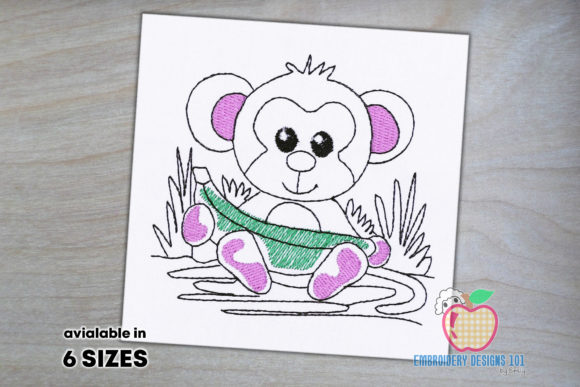
As an embroidery designer who’s prepped over 200 craft fair booths—and shipped thousands of embroidered tote bags, tea towels, and patches—I opened Girl Monkey with Banana expecting charm. What I found was more: a quick-stitch machine embroidery design that lands squarely in the “instant booth magnet” category. It’s not overly sweet or cartoonish—it’s got cheeky personality, clean line work, and just enough sketch-like looseness to feel handmade without sacrificing clarity. Customers don’t pause to decode it; they smile, point, and ask, “Do you have that on a bag?” That’s gold at a weekend market.
Where Girl Monkey with Banana Shines—And Where It Needs Support
On a natural canvas tote? Perfect. The open sketch style breathes on unbleached cotton, and the banana adds a pop of implied color—even when stitched in neutral thread (think oat, charcoal, or olive). As an apron embroidery, it sits beautifully above the pocket—big enough to read from three feet away, small enough to avoid overwhelming the bib. For tea towel embroidery, I’d place it low on the hem: playful but grounded, reinforcing kitchen joy without competing with flour-dusted countertops.
As an embroidered patch? Strong contender. Its non-filled nature means crisp edges and minimal bulk—ideal for iron-on or sew-on applications on denim jackets, backpacks, or kids’ lunchboxes. On curved surfaces like caps? Proceed with care: test stitch density first. The monkey’s ear and banana stem are slender—too much pull on stretchy twill can distort them. A lightweight cutaway stabilizer + reduced top tension keeps lines sharp.
For pillow covers and fabric pouches? Yes—but size matters. At 3.5”, Girl Monkey with Banana reads as a charming accent. At 5”, it becomes a statement. Avoid scaling below 2.75”: the banana curve softens, and the monkey’s facial suggestion blurs. This isn’t a design that thrives at 1.8”—it’s built for presence, not postage stamps.
Real-World Craft Fair Performance
In my booth, Girl Monkey with Banana consistently draws younger shoppers and gift buyers—not just kids’ section browsers, but adults buying for nieces, teachers, or themselves (“I *am* the girl monkey,” one customer laughed while grabbing two pouches). It stands out among florals and monograms because it’s narrative, not decorative. It tells a micro-story: curiosity, play, lightness. That makes it memorable in a sea of generic “Hello Sunshine” or “Bless This Mess” embroidery.
It also photographs exceptionally well for Etsy sellers. The sketch aesthetic translates cleanly to flat-lay shots—no heavy fill to cast distracting shadows. Pair it with a textured linen tea towel or a woven market bag, and your printable mockup feels warm, intentional, and shop-ready. No need for filters: the design’s inherent rhythm does the work.
Production Practicality: Fast, Flexible, But Not Foolproof
“Quick Stitch” isn’t marketing fluff here. With moderate stitch density and no dense fills, Girl Monkey with Banana runs smoothly across mid-range machines—even older Brother or Janome models. That’s critical when you’re stitching 40+ tote bags the night before a fair. Batch production is realistic: consistent spacing, balanced thread pull, and predictable hoop time.
But “not 100 filled” means attention to fabric texture. On thick terry cloth towels or looped jacquard, the open areas may sink or pucker. Use a tear-away + light cutaway combo, and baste the fabric taut—not stretched. Dark fabrics? Confirm thread contrast: a medium-brown monkey on navy reads warmly; pale yellow banana on black risks vanishing unless you add a subtle satin underlay (check your embroidery file settings).
Careful-Use Notes Every Designer Should Check
- Tiny details: The banana’s tip and monkey’s tail curl are delicate—avoid ultra-fine threads (60wt+) on dense fabrics.
- Small lettering: There is none—this is pure illustration. A huge advantage for readability and scalability.
- Curved surfaces: Caps and curved pouches demand test stitches. Reduce density by 10–15% if distortion appears.
- Fabric texture: Highly napped or fuzzy fabrics (like sherpa or fleece) will obscure fine lines—stick to smooth weaves for best clarity.
- Dark fabric: Always test thread colors on your base fabric. What looks vibrant on screen may mute on charcoal linen.
Design Integrity Meets Business Sense
Girl Monkey with Banana strengthens brand consistency for small shop owners who balance whimsy with craftsmanship. It doesn’t scream “cute overload”—it whispers “thoughtfully made.” That perception lifts perceived value: customers pay more for embroidered items that feel intentional, not mass-produced. In a booth display, it pairs effortlessly with other Wild Animals embroidery (think foxes or owls), but its personality ensures it doesn’t get lost in the group.
For digital sellers, this embroidery file is a smart asset: multiple sizes mean flexible licensing tiers (personal use → small shop commercial → wholesale). Just confirm the license permits finished product sales before listing embroidered pouches or tea towels on Etsy. And always—always—test the design on scrap fabric matching your final product: same thread, same stabilizer, same hoop size.
Final Designer Notes Before You Stitch
- Test on scrap fabric *identical* to your production material.
- Check thread contrast under natural light—not just your studio lamp.
- Review spacing between monkey and banana: too tight loses airiness; too loose breaks the visual link.
- Confirm hoop size compatibility—especially if offering large-format versions for tote bags.
- Inspect stitch density visually: look for skipped stitches in curves, not just on-screen.
- Use the right stabilizer: tear-away for stable wovens, cutaway for knits or stretchy blends.
- Create at least one real mockup—not just a digital preview—before committing to 50 units.
- Compare how it reads on light vs. dark fabric swatches side-by-side.
- Verify commercial licensing terms before selling any finished product.
Bottom line? Girl Monkey with Banana isn’t just another embroidery file. It’s a craft fair catalyst—a handmade product engine disguised as a sketch. When stitched right, it turns functional items into joyful keepsakes. And in a world of fast-scrolling feeds and crowded market aisles, that kind of quiet delight? That’s what sells.