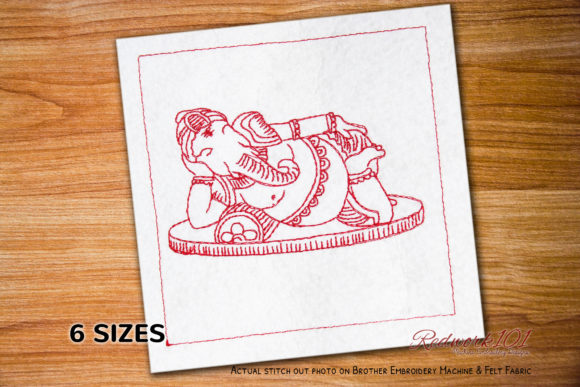
Ganesh Idol Indian Culture Redwork
A Thoughtful Design Review for Small Business Merchandise
As an embroidery designer who’s developed hundreds of commercial designs for cafés, boutiques, florists, pet brands, and handmade studios, I approach Ganesh Idol Indian Culture Redwork not just as a religious motif—but as a functional, brand-forward machine embroidery design. Right away, the title signals cultural resonance and visual warmth: “Redwork” evokes hand-stitched tradition, while “Ganesh Idol” suggests reverence, auspiciousness, and artisanal storytelling. This isn’t generic clip art—it’s a design with intention, rooted in symbolism yet built for real-world application.
First Impression: Elegant, Handmade, and Brand-Ready
The name alone communicates authenticity and craft—ideal for small businesses that lean into heritage, mindfulness, or locally made values. It feels elegant without being stiff, handmade without looking amateurish, and visually grounded enough to pair with modern typography or minimalist packaging. Unlike overly ornate deities rendered in dense fill stitches, this redwork style implies openness, breathability, and stitch-friendly line work—critical when scaling for embroidered patches or cap fronts.
Where Ganesh Idol Indian Culture Redwork Shines in Business Use
- Embroidered patches: Works beautifully as a sew-on or iron-on patch on tote bags, aprons, or staff jackets—especially when backed with twill or felt for durability.
- Apron embroidery: Perfect for boutique cafés or yoga studios wanting subtle spiritual grounding—not overt branding, but quiet intention stitched into daily wear.
- Cap embroidery: At 2.5–3 inches wide, it holds clarity on curved crowns without losing definition; the optional box stitch adds framing control if needed.
- Tote bag design: Scales well centered on cotton canvas or jute—its redwork lines read cleanly even at mid-size, avoiding the “muddy” effect common with high-density fills.
- Product packaging accents: Think branded tea tins, soap wraps, or handmade candle boxes—embroidered onto fabric labels or stitched directly onto textured paper-backed fabric tags.
- Customer gifts & event merch: A small Ganesh Idol Indian Culture Redwork patch included with a purchase reinforces brand care and cultural respect—especially meaningful for wellness studios, Ayurvedic shops, or creative retreats.
Use With Care: Practical Embroidery Considerations
This design demands thoughtful execution—not because it’s difficult, but because its impact hinges on precision. Avoid using Ganesh Idol Indian Culture Redwork on surfaces where detail suffers: ultra-small patches under 1.75”, highly curved cap bills, or tightly knit fabrics like velour without proper stabilizer. The outer box (noted as optional) can help anchor placement—but only if color contrast is strong. On dark uniforms or textured denim, test thread colors first: deep maroon or burnt sienna often reads richer than true red on black fabric.
Also watch for stitch density. While redwork typically avoids heavy fills, confirm whether inner elements (like lotus petals or modak outlines) rely on satin stitch borders or delicate running stitches—if so, they’ll need sharp needles and medium-weight cutaway stabilizer to prevent puckering on stretchy or loosely woven materials.
How It Strengthens Brand Identity & Customer Trust
For small businesses, every embroidered element is a silent ambassador. Ganesh Idol Indian Culture Redwork doesn’t shout—it invites. That makes it ideal for brands that prioritize meaning over mass appeal: a florist honoring seasonal cycles, a bakery celebrating festivals with themed aprons, or a pet wellness brand weaving in harmony and new beginnings. Customers recognize authenticity when craftsmanship aligns with values—and this design delivers that alignment without cliché.
It also supports visual consistency. Pair it with clean sans-serif logos or earth-toned packaging, and you create layered storytelling: digital + tactile, modern + traditional, local + global. And because it’s rooted in Religion yet presented through Embroidery craft—not graphic overlay—it feels earned, not appropriated.
Essential Designer Notes Before Production
- Test in black and white first: Confirm legibility of key lines without color reliance—especially important for monochrome uniforms or grayscale mockups.
- Check minimum size viability: Resize to your smallest intended use (e.g., 1.5” patch) and verify all motifs remain distinct—not merged or pixelated in stitch simulation.
- Review thread color contrast: Redwork traditionally uses red thread on natural fabric—but for branded merch, consider ecru thread on navy, charcoal on oatmeal, or gold on burgundy for elevated tone-on-tone effects.
- Inspect spacing and isolation: Ensure no floating elements or tight corners that could snag during washing or wear—critical for aprons and staff uniforms.
- Confirm hoop size compatibility: If your embroidery machine uses standard 4x4 or 5x7 hoops, make sure the design fits comfortably within those bounds—including any optional box frame.
- Test on real fabric: Run a sample on your actual garment or patch substrate—not just tear-away stabilizer—to assess drape, stiffness, and thread sheen.
- Create a printable mockup: Show clients how Ganesh Idol Indian Culture Redwork looks stitched—not just placed—as part of their full design assets.
- Compare beside other assets: Does it harmonize with your logo, typography, and secondary icons? Consistency builds recognition faster than novelty.
- Verify commercial licensing: Since this is intended for small business merch, custom apparel, and commercial embroidery, ensure your digital embroidery file includes rights for resale and client projects.
Final Thought: More Than a Design—A Meaningful Touchpoint
Ganesh Idol Indian Culture Redwork succeeds where many cultural motifs fall short: it balances reverence with versatility, tradition with adaptability, and detail with durability. For embroidery shops, Etsy sellers, and product designers building authentic connections through handmade product, it’s not just another embroidery file—it’s a conversation starter, a trust builder, and a quietly powerful piece of your brand identity. Used intentionally, it transforms ordinary merchandise into something memorable, meaningful, and unmistakably human.