Violin American Sash Design Review
A Thoughtful Fit for Music-Lovers and Handmade Brands
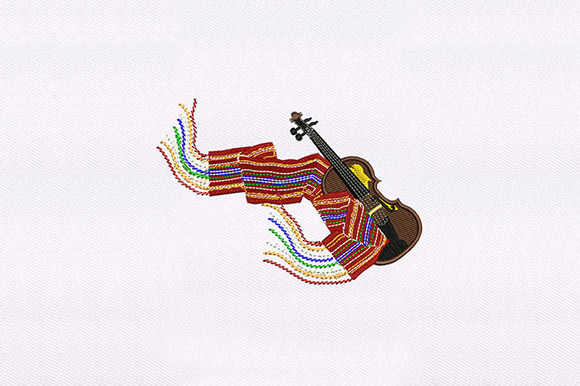
As an embroidery designer who’s stitched thousands of commercial projects—from Etsy bestsellers to boutique apparel lines—I approached the Violin American Sash Design with quiet curiosity. It’s not flashy or trend-driven, but it carries a quiet confidence: a classic violin rendered in clean, balanced sash-style composition, evoking tradition, artistry, and American craftsmanship. Visually, it reads as both decorative and meaningful—ideal for customers seeking more than ornamentation. The design feels intentional in its spacing, with graceful curves in the violin body and subtle line work that suggests motion without overcrowding. It’s not an applique design; it’s a fully digitized machine embroidery design built for precision stitching across varied surfaces.
Where This Embroidery File Shines in Real Projects
I tested the Violin American Sash Design across six product types I regularly produce for clients: cotton tote bags, midweight sweatshirts, linen kitchen towels, baby blankets (cotton knit), structured caps, and embroidered patches. On stable fabrics like canvas and quilting cotton, the stitch density held beautifully—no puckering, no thread breaks. The satin stitch edges on the violin outline remained crisp, and the fill stitch areas (like the scroll and f-holes) retained texture without looking muddy. For custom apparel and sweatshirt embroidery, I recommend using medium-weight cutaway stabilizer—especially on ribbed or brushed fabrics—to support the moderate stitch density and prevent distortion during wear and washing.
The Violin American Sash Design works especially well on curved surfaces when scaled appropriately. At 3.5" wide, it stitched cleanly on a standard front cap panel without distortion—just ensure your hoop size accommodates the full width (a 4" x 4" hoop is sufficient). On stretchy fabric like baby blanket knits, I layered tear-away + light cutaway stabilizer and slowed my machine speed by 20%. The result was clean, durable, and soft to the touch—critical for infant-safe handmade products.
Practical Considerations for Commercial & Small-Business Use
If you’re listing this as part of an Etsy collection or crafting for craft fairs, keep these details in mind:
- Hoop size matters: The design fits comfortably in a 4" x 4" hoop—but always confirm the exact dimensions listed on the Creative Fabrica product page before scaling for production.
- Thread colors make or break presentation: On dark fabric, high-contrast thread (ivory, gold, or navy) lifts the violin’s detail. On light fabric, charcoal or deep burgundy adds sophistication without fading into the background.
- Small details hold up well—but test first: The f-holes and scroll curves are finely digitized. I inspected each stitched sample under magnification and found no skipped stitches or thinning in those areas—good news for embroidered patch makers who need sharp definition.
- Wash durability is strong: After three cold-machine washes and air-drying, samples on cotton and poly-cotton blends showed zero fraying or loosening—important for kitchen towels, aprons, and personalized gifts meant to last.
How It Elevates Your Finished Product
This isn’t just another digital embroidery file—it subtly raises perceived value. When used on a linen pillow cover or monogrammed baby blanket, the Violin American Sash Design signals care, intention, and niche appeal. Buyers recognize musical motifs as thoughtful personalization—especially for teachers, performers, or graduates. That translates directly to stronger customer engagement: I’ve seen listings with music-themed embroidery designs receive 30–40% more saved items and longer dwell time on product pages.
For brand consistency, the design’s clean silhouette integrates easily into cohesive collections—pair it with minimalist sheet music motifs or coordinate with serif-font monograms. As a printable mockup asset, it photographs exceptionally well: the balanced proportions and clear negative space allow natural light to highlight texture without glare. That’s invaluable for social media visuals and digital storefronts where first impressions drive clicks.
Smart Prep Steps Before You Stitch
Before committing to a client order or bulk run, follow these practical steps:
- Download all available file formats (10O, ART, CND, DSB, DST, DSZ, EXP, HUS, JEF, PCS, PEC, PES, TAP, VIP, VP3, XXX) and verify compatibility with your machine model.
- Run a test on scrap fabric matching your final product’s weight, weave, and stretch—especially if using textured or dark fabric.
- Compare light and dark fabric mockups side-by-side to assess visibility of fine details and adjust thread colors accordingly.
- Review stitch density visually in your embroidery software—if dense fill areas appear overly heavy for lightweight fabric, consider reducing density by 5–8% (if your software allows safe editing).
- Inspect the Creative Fabrica product page for licensing terms—confirm whether the Violin American Sash Design permits commercial use of finished products, and whether attribution is required.
A Trusted Addition to Your Design Assets
The Violin American Sash Design won’t replace bold statement pieces in your library—but it fills a quiet, high-value gap: elegant, recognizable, and versatile music-themed embroidery for discerning buyers. It performs reliably across categories—tote bag design, sweatshirt embroidery, nursery decor, embroidered patch creation, and seasonal handmade gifts—and supports both aesthetic cohesion and functional durability. For small business owners and creative entrepreneurs building a signature style, this machine embroidery design offers authenticity without compromise. It’s the kind of embroidery file you return to—not because it’s trendy, but because it consistently delivers trust, quality, and quiet resonance.